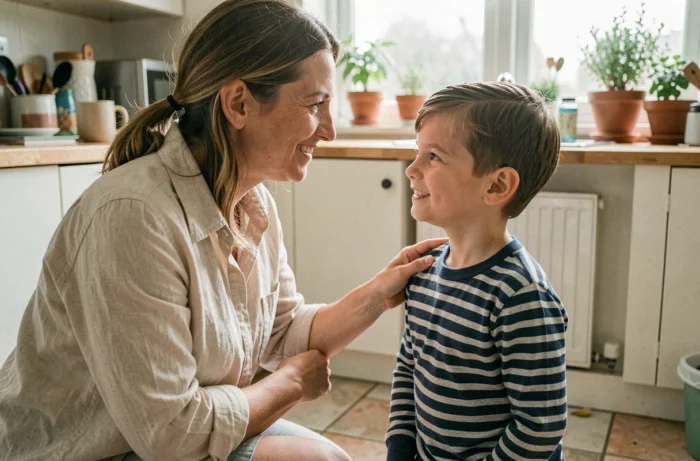
Positive education refers to a set of educational practices based on listening, respecting the child’s development, and encouragement rather than punishment. It does not aim for parental perfection but rather a constant adjustment to the real needs of each child, according to their age and temperament. Here are ten concrete tips for integrating it into family life without unnecessary pressure.
1. Rephrase instructions in affirmative sentences
A young child’s brain struggles with negation. Saying “don’t run” requires them to imagine the action before inhibiting it. Rephrasing to “walk slowly” provides a clear and immediate direction.
This habit requires an adjustment period for parents. A simple guideline: every time a sentence starts with “don’t…,” transform it by describing the expected behavior. Stating what we want to see rather than what we want to avoid reduces misunderstandings and repetitions.
2. Name emotions out loud
Putting a word to what the child feels provides them with a regulation tool. “You are frustrated because your toy isn’t working” validates their feelings without endorsing inappropriate behavior. To delve deeper into the principles underlying this approach, positive education on Mes Petits Pas details complementary strategies.
Naming the emotion helps the child build their emotional vocabulary, which gradually facilitates self-regulation. This verbalization also works for the parent: saying “I am annoyed” models a healthy way to manage anger.
3. Offer limited choices to develop autonomy
Providing two options (“do you want the blue pants or the gray ones?”) gives the child a sense of control without opening up an infinite negotiation field. The framework remains defined by the parent, but the child participates in the decision.
This technique works particularly well during transition moments (getting dressed, meals, leaving). It reduces direct opposition because the child focuses on the offered choice rather than the overall refusal of the instruction.

4. Adapt expectations to the developmental stage
Expecting a two-year-old to sit calmly during a long meal does not align with their neurological capacity. Positive education practices become more effective when they take into account the child’s actual development, not a theoretical ideal.
The effects of positive parenting vary according to the age and temperament of each child. Adapting expectations also means accepting that “difficult” behavior can be perfectly normal at a given stage. This prevents turning what is part of a growth stage into a conflict.
5. Replace punishment with repair
When a child spills their drink, asking them to wipe the table is more educational than a time-out. Repair establishes a logical link between the act and its consequence, which arbitrary punishment does not do.
This principle also applies to social interactions. A child who snatches a toy can be guided towards returning it with a word (“here, that was theirs”) rather than facing a punishment disconnected from the situation.
6. Establish a daily reconnection time
Setting aside a short time, even ten minutes, for an activity chosen by the child without screens or distractions strengthens the parent-child bond. This predictable appointment reassures the child and reduces attention-seeking behaviors.
This time does not need to be spectacular. Reading a story, playing on the floor, drawing together: regularity matters more than the duration or quality of the activity.
7. Use “I” statements instead of accusatory “you” statements
“You are mean” traps the child in a negative identity. “I don’t like it when you hit” distinguishes the behavior from the person. This formulation preserves self-esteem while setting a clear limit.
Communication in “I” works in three steps: describe the observed fact, express your feelings, state your expectation. It also applies between adults and contributes to a more peaceful family climate.
8. Anticipate crisis situations with visual routines
Crises often occur during transitions. A visual aid (sequence of images for the morning, pictograms for bedtime) allows the child to navigate the day’s flow without relying solely on the parent’s verbal reminders.
- Display the morning routine on the bathroom wall (wash up, get dressed, have breakfast) so the child can follow the steps independently.
- Use a visual timer before each activity change, making the remaining time concrete.
- Prepare the necessary items (clothes, backpack) the night before to reduce morning stressors.
Anticipation reduces conflicts related to transitions because it replaces sudden commands with a predictable framework.
9. Acknowledge your own limits as a parent
Positive education does not mean staying calm all the time. Recent research on parental stress highlights the need to quickly recognize feelings of overwhelm and plan simple recovery strategies: a few seconds of pause, a brief physical activity, a chat with a loved one.
Telling your child “I need a minute to calm down” is not an admission of failure. It is a model of emotional management that the child will internalize in turn.
10. Encourage effort rather than results
“You worked hard” has a different effect than “you are smart.” The first formulation values the process, motivating the child to persevere in the face of difficulty. The second creates a fixed identity that can generate anxiety in the face of failure.
- Describe precisely what you observe (“you tried that puzzle three times, that’s perseverance”) rather than giving a vague compliment.
- Avoid systematic superlatives (“the most beautiful drawing in the world”) that lose their credibility.
- Let the child evaluate their own work before giving feedback, which develops their critical sense.
Valuing the process over performance builds lasting confidence in the child.
These ten practices do not form a rigid method. The parenting support programs that show the best results are those that offer gradual training, with concrete opportunities to practice, rather than a list of abstract principles. Each family adjusts the dial according to its pace, constraints, and the temperament of its children.