
Welcoming a pet involves a commitment that often exceeds a decade. A cat lives on average between fifteen and twenty years, while a dog lives between ten and fifteen years depending on its size. This longevity necessitates structuring the welcome, care, and organization of the home well before the arrival of the animal.
Actual cost of a pet over its lifetime
Most guides detail feeding or hygiene, but few address the overall budget over the animal’s entire lifespan. This is, however, the primary factor for abandonment outside of holiday periods. The expense items accumulate: food, antiparasitics, vaccines, sterilization, health insurance, accessories, and especially unexpected veterinary costs.
A often underestimated expense concerns sterilization and dental care. These procedures, rarely covered by entry-level contracts, represent significant amounts, especially for large dogs or cats prone to tartar.
Before adopting, the most reliable approach is to request a preliminary estimate from a veterinarian for the species and breed considered. The resources available on animagora.fr also allow for comparing equipment and supplies suitable for each type of animal.
- Quality food tailored to age, breed, and health status (sterilized, senior, sensitive animal).
- Regular antiparasitic treatments (fleas, ticks, dewormers) renewed several times a year.
- Financial provision for veterinary emergencies, which can occur unexpectedly at any age.
- Boarding or pet-sitting fees in case of prolonged absence, an expense that quickly rises during holidays.
Identification and regulation: what changes with the European regulation
Identification by microchip is already mandatory in France for dogs and cats. The novelty comes from the European regulation on the welfare of dogs and cats, which is set to be generally applied from August 31, 2028. This text harmonizes microchip identification, registration in interoperable databases, and the rules applicable to breeders, sellers, shelters, and owners across the Union.
In practical terms, this means that an animal identified in France will be traceable in any other member country, which facilitates searches in case of loss abroad. For owners, updating contact information in the national file remains the most effective action to maximize the chances of finding a lost animal.
The regulation also provides for stricter oversight of certain holding practices and equipment. Owners will need to verify, by 2028, that their housing conditions comply with the new standards.
Saturation of shelters and owner responsibility
French shelters are facing increasing pressure. The study published by the SPA and the Affinity Foundation in September 2026 indicates that approximately 391,000 dogs and cats were taken in during 2025, while over 84,000 were turned away due to lack of space. The summer of 2026 saw another increase in intakes compared to the previous year, with a significant rise in reports of abuse.
These figures do not only concern summer abandonments. The trend is structural: uncontrolled births of kittens, financial difficulties, family separations. Sterilization remains the most effective lever against overpopulation in shelters.
Anticipating unforeseen care situations
Even before welcoming an animal, it is essential to plan a reliable care solution for absences (holidays, hospitalization, business trips). Boarding, in-home pet sitters, foster families: each option has different costs and logistical constraints.
The foster family contract, particularly for associations, legally frames the responsibility in case of damage or return. A contractual clarification protects both the animal and the temporary holder.

Adapting the home environment to the chosen species
An apartment cat does not have the same needs as a shepherd dog in a house with a garden. A common mistake is to choose a breed for its appearance without checking its compatibility with the available space and the household’s lifestyle.
Checkpoints before the animal’s arrival
- Secure access points (balcony, tilt-and-turn windows for cats, fences for dogs) and remove toxic plants.
- Plan distinct resting areas, away from traffic, with bedding suitable for the animal’s adult size.
- Place food and water bowls in a quiet area, separate from the litter box for cats.
For rodents and birds, the size of the cage or terrarium directly affects their well-being. A space that is too small generates chronic stress, stereotypical behaviors, and long-term health issues.
Physical activity and mental stimulation
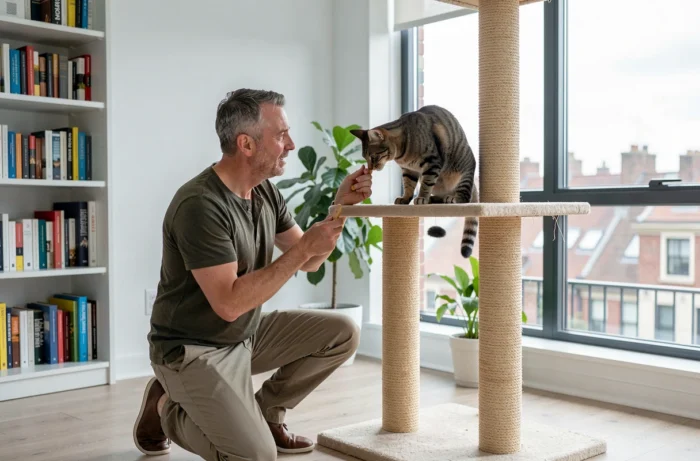
Lack of exercise is one of the primary causes of behavioral problems in dogs (destruction, barking, separation anxiety). Two daily outings of at least thirty minutes are a minimum for most breeds. Indoor cats, on the other hand, need enrichment: cat trees, rotating toys, interactive play sessions.
A bored animal develops behaviors that the owner often interprets as disobedience, while it is actually a signal of distress related to an impoverished environment.
Welcoming an animal under good conditions therefore requires a realistic budget, an appropriate living environment, and anticipation of absence periods. With a European regulation tightening obligations starting in 2028 and saturated shelters that can no longer absorb missteps, preparation in advance has never been more crucial.