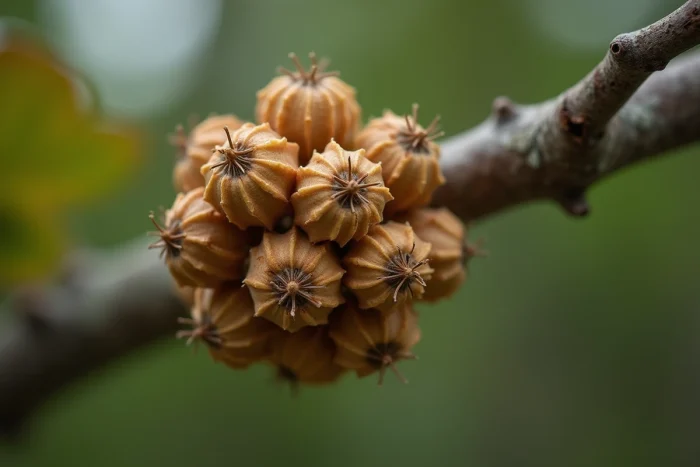
We often come across these small round balls attached to the leaves or branches of an oak tree, sometimes while out for a walk with children. The instinct is to touch them, open them, or even pick them up to examine them. Oak galls raise concrete questions: is it dangerous to touch them, and what happens if a child puts one in their mouth?
Molds and allergenic spores in fallen galls on the ground
The formation of galls by cynipid wasps, these tiny wasps that lay eggs in the tissues of the oak, is well documented. What is less understood is what develops inside the gall once it is on the ground.
A microbiological study published in 2023 (S. Pusz et al., Fungal Ecology) shows that dry galls host specific fungal communities, distinct from those found on the leaves or bark of the same tree. Regularly found genera include Alternaria and Cladosporium, known for their allergenic properties in aerosol form.
If a dry gall is crushed or handled in a closed space (a workshop, a closed room, indoors), the spores released can pose a problem for individuals highly sensitive to molds. Outdoors, dispersion limits the risk. The authors of the study recommend considering crushed dry galls as a potential vector of spores for those allergic to molds.
To delve deeper into the risks of oak galls for humans, we can distinguish two very different situations: occasional handling in the forest and prolonged use in a craft or cosmetic context.
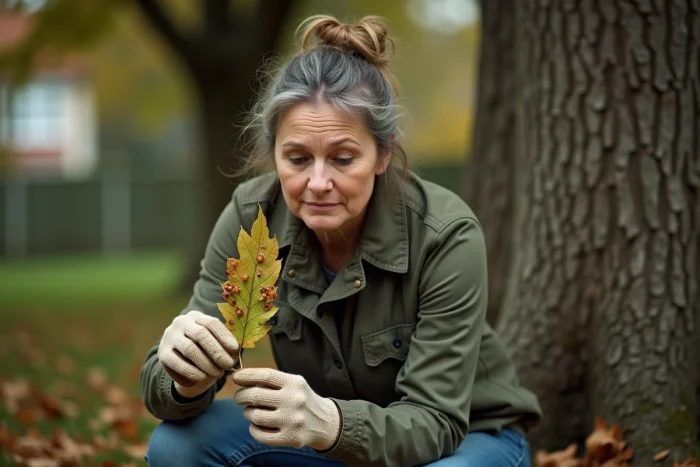
Oak gall and skin contact: what touching really causes
In the field, the question often arises among parents and gardeners. Touching a fresh gall on an oak does not cause burns or skin reactions in the vast majority of people. It is not a stinging plant, and the gall itself is a plant tissue modified by an insect’s egg-laying.
The gall contains tannins, sometimes in high concentrations. These astringent compounds can slightly dry the skin with prolonged contact, but we are talking about repeated handling over several hours, not a one-time pick-up.
Situations where caution is warranted
- Open or damaged galls on the ground for several weeks may contain visible molds (powdery texture, grayish coloration). It is advisable to avoid crushing them with bare hands, especially if there are cuts or weakened skin.
- Young children spontaneously put these objects in their mouths. While there is no acute danger in small quantities, ingesting fragments of gall rich in tannins can cause nausea or irritation of the mouth.
- Individuals undergoing dermatological treatment or with active eczema should wash their hands after handling, more as a precaution than due to any proven medical necessity.
In summary, brief contact is not a problem. It is the repetition or ingestion that changes the situation.
Concentrated tannins and homemade preparations: the real identified danger
The risk associated with oak galls does not come from walking in the forest. It arises from the misuses circulating online.
For several years, recipes using crushed oak galls have been circulating on social media, presented as natural remedies, particularly for “tightening” vaginal mucous membranes. The French Poison Control Centers and ANSES reported in a 2024 toxicovigilance bulletin an increase in cases of local burns and acute pelvic pain related to these homemade preparations.
Some of these consultations have led to emergency care. No serious long-term sequelae have been reported in documented cases, but the described pain is intense enough to require medical attention.
Hydrolyzable tannins and toxicity threshold
The hydrolyzable tannins present in oak galls, studied particularly in the context of animal feed additives, can become nephrotoxic and hepatotoxic beyond certain concentration thresholds. The concentration of tannins in a homemade preparation is impossible to control without analytical equipment.
Applying crushed gall directly to a mucous membrane amounts to exposing fragile tissue to an unknown dose of astringent and potentially irritating compounds. This is far from the innocuous contact with an intact gall on a tree.
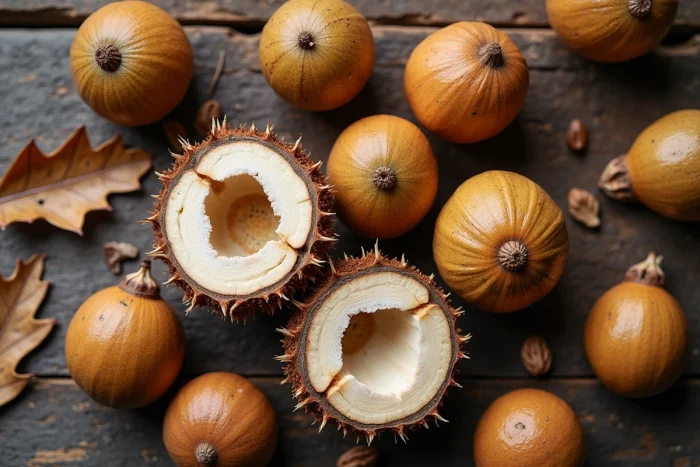
Oak gall in the garden: should you treat or remove galls from your trees?
On a garden oak, the presence of galls does not threaten the health of the tree in most cases. Cynipid wasps cause a localized tissue reaction, but the tree does not suffer significant structural damage unless there is massive infestation over several consecutive years.
Feedback varies on this point: some arborists observe a gradual weakening of heavily infested branches, while others see no measurable impact on healthy adult specimens.
What can be done concretely
Manually removing galls does not have a preventive effect on future generations of cynipid wasps. The adult insect has already emerged when the gall is spotted. If you wish to limit proliferation, collecting fallen galls in the autumn reduces the number of larvae that will overwinter on site.
No approved chemical treatment specifically targets oak cynipids in a private garden context. Regulation occurs naturally through parasitoids (other micro-hymenopterans that lay eggs in occupied galls).
The oak gall remains more of a curiosity than a health hazard. The only documented real risk concerns the concentrated and unregulated use of the tannins it contains, particularly on mucous membranes. For the rest, you can pick it up, observe it, show it to children, and simply wash your hands afterward.