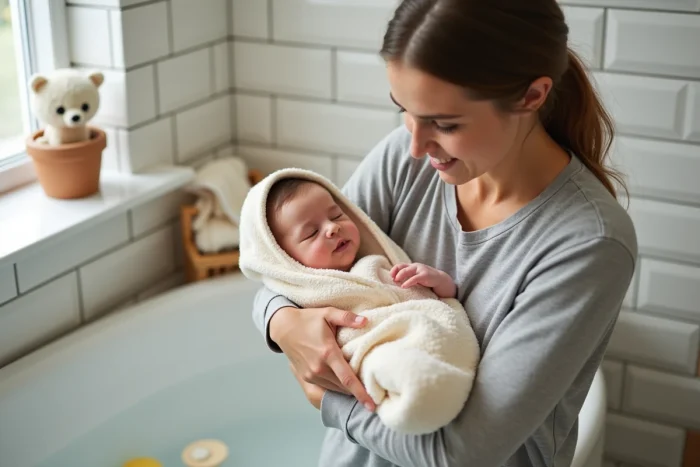
The evening bath is often presented as a moment of relaxation for the infant. The physiological reality is more nuanced: for a baby who is already tired, immersion in water can produce the opposite effect and cause hyper-excitation that is difficult to resolve. Understanding the mechanisms at play allows for adjustments to the ritual so that it remains beneficial for sleep.
Immature thermoregulation of the infant and energy expenditure during the bath
An infant’s thermoregulation system during the first trimester of life is far from fully developed. Their body must exert metabolic effort to maintain a stable internal temperature when transitioning from a dry environment to water, and then from water to open air.
This phenomenon is often underestimated. The rapid transition from a warm bath to a cooler room forces the infant’s body to mobilize its energy reserves to compensate for the temperature difference. It is precisely this thermal adaptation that can exhaust a baby whose resources are already limited at the end of the day.
As detailed in the analysis of baby fatigue according to Mômes et Merveilles, the combination of sensory stimulation (water contact, light, body handling) and thermal effort creates an overall load that sometimes exceeds the infant’s ability to adapt.
| Stimulation Factor | Soothing Effect (rested baby) | Exhausting Effect (already tired baby) |
|---|---|---|
| Contact with lukewarm water | Muscle relaxation, containing sensation | Possible sensory overload |
| Temperature variation (getting out of the bath) | Slight drop in internal temperature promoting sleep | Intense energy mobilization, thermal stress |
| Body handling (washing, drying) | Gentle massage, parent-baby bond | Nervous system excitation, crying |
| Bright and noisy environment | Calm transition if dim lighting | Hyper-vigilance if bright light or noise |
Cortisol and sleep debt: why the evening bath worsens fatigue
INSERM, in a 2024 summary on children’s sleep, emphasizes that cortisol regulation at the end of the day is very sensitive to overly stimulating routines. A baby with sleep debt has a higher evening cortisol level, making them vulnerable to any additional stimulation.
Cortisol is a stress hormone that, in normal amounts, follows a decreasing cycle throughout the day. In a well-rested infant, the evening bath takes advantage of this natural decline to enhance relaxation. Conversely, in a baby who has not slept well during the day or who has missed naps, cortisol remains elevated.
In this configuration, water, light, and body handling act as stimulants instead of calming. The baby’s nervous system switches to alert mode, delaying sleep onset and worsening sleep deficit in the following period.
The vicious cycle of fatigue-cortisol-bath
The mechanism perpetuates itself. A baby who has difficulty falling asleep after the bath accumulates sleep debt. The next day, their evening cortisol level is even higher, and the evening bath triggers another stress reaction. Breaking this cycle requires action on the timing of the bath, not just its duration.
Moving the bath to the afternoon: what pediatricians recommend
Several North American pediatric hospitals, including the Hospital for Sick Children in Toronto, have updated their parental recommendations since 2022. They advise against routine evening baths for infants suffering from sleep disorders or reflux.
Their recommendation is to move the bath earlier in the afternoon to dissociate thermal and sensory stimulation from bedtime. The American Academy of Pediatrics supports this by recommending keeping the last hour before bedtime as calm as possible.
Adapting the timing to the life trimester
The first trimester of life is the period when thermoregulation is most fragile and sleep is least consolidated. It is also the time when the evening bath is most likely to produce the opposite effect of what is desired. As the baby grows and their sleep cycles stabilize, tolerance for evening baths increases.
- Before three months: prioritize bathing in the middle of the day, away from nap windows and bedtime, ensuring that the room temperature limits the thermal difference upon exit
- Between three and six months: test bathing in the late afternoon, observing if the baby shows signs of stress (crying, stiffness, agitation) or relaxation (muscle release, calm gaze)
- After six months: the evening bath becomes a viable option for most infants, provided that sleep debt is not established
Reducing the sensory load of the bath: three concrete levers
The timing of the bath is not the only parameter. The overall sensory load determines whether the bath tires or soothes.
The water temperature plays a direct role in energy expenditure. Water that is too hot forces the baby’s body to dissipate heat, which mobilizes energy and increases alertness. Maintaining a moderate temperature reduces this effort.
The lighting environment conditions melatonin production. A bath taken under bright lighting delays the secretion of this sleep hormone. Dimming the bathroom light significantly alters the infant’s response.
The duration of the bath itself is a factor in fatigue. A short bath, lasting a few minutes, is sufficient for hygiene and relaxation without exhausting the baby’s adaptation capacities. Extending the bath beyond this threshold increases stimulation without additional benefit.

A gentle massage after the bath, performed in a calm environment, can help lower cortisol levels and extend the soothing effect of the water. This transition between the bath and bedtime partially compensates for the stimulation experienced, provided it remains slow and quiet.
The bath remains a precious moment in the life of the infant. The goal is not to eliminate it, but to position it at the right time and control its sensory intensity so that it serves sleep instead of compromising it.