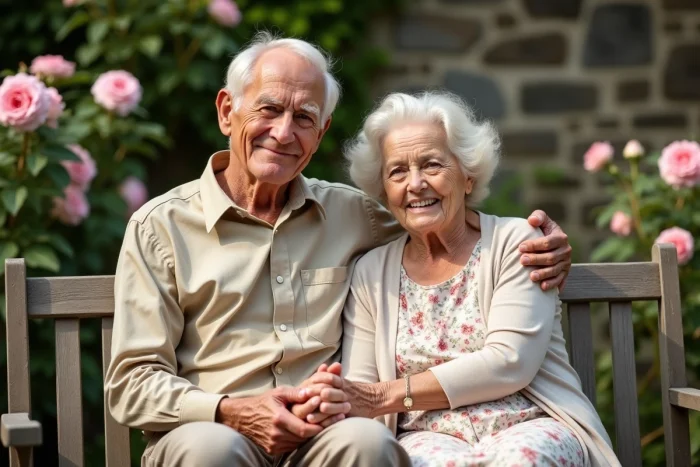
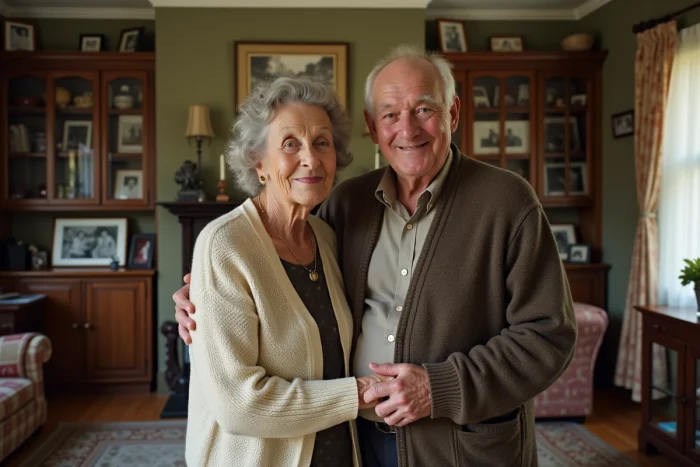
Eleanor and Lyle Gittens, aged 107 and 108 respectively, have been married for over 83 years. This figure places the American couple at the top of the longest documented unions. Behind this record lies a reality less romantic than the headlines suggest: extreme marital longevity depends as much on biology as on emotional bonds, and the health challenges faced by ultra-elderly spouses remain a blind spot in typical narratives.
Asymmetrical health of spouses: the challenge that centenarian marriage records do not reveal
Couples who reach the milestone of 80 years of marriage share a rarely mentioned commonality: the daily management of sometimes significant health disparities between the two partners. One may remain independent while the other falls into heavy dependence.
Field reports from nursing homes indicate a significant increase in forced separations due to unilateral dependence since 2023. When only one spouse requires placement in a specialized unit, the couple is separated by the institution itself. Some facilities are experimenting with adapted cohabitation arrangements to maintain shared living, but these initiatives remain marginal.
This is where artificial intelligence and telemedicine could change the game. Remote monitoring tools already allow for the observation of a dependent spouse’s vital signs without imposing permanent hospitalization. The challenge for the coming decades is to enable elderly couples to stay together despite divergent health conditions, by adapting care at home rather than separating spouses by default.
To delve deeper into the issue of marital longevity records, one can consult the oldest couple in the world on Seniors Actu, which outlines the most documented journeys.
Longest marriage records: who are the verified couples
The current record belongs to Eleanor and Lyle Gittens, married since 1942. Their union exceeds 83 years. Before them, other couples had approached or surpassed the 80-year marriage mark, such as Waldemar and Dolores Dino in Brazil.
Verifying these records poses a methodological problem. The civil registries of some countries do not go back far enough or have gaps. Only couples whose marriage certificate is verifiable can claim official recognition. The available data do not allow for a definitive conclusion that all self-proclaimed records withstand rigorous documentary scrutiny.
What distinguishes ultra-long unions
Several factors emerge in the testimonies of couples who have surpassed 70 or 80 years of life together:
- A marriage contracted very young, often before the age of 25, which mechanically extends the possible duration of the union.
- An absence of prolonged geographical separation, with couples remaining in the same region exhibiting greater stability.
- A dense family network that provides informal care support, delaying institutionalization.
These characteristics do not constitute a recipe. They describe a statistical profile, not a reproducible method.
Marriage in France: a declining context that makes longevity even rarer
The number of marriages celebrated in France has seen a marked decline in recent years. The rise of PACS (civil partnerships) and cohabitations without legal formalization reduces the number of unions that could one day become centenarian. This trend contrasts with the stability of marital longevity observed among generations born before 1950.
Every year in France, around 250,000 marriages are celebrated, but the curve is declining. For a couple to reach 80 years of marriage, both partners must live beyond 100 years. Life expectancy is increasing, but not uniformly between men and women, creating a biological bottleneck.
Japan, an enlightening counter-example
In Japan, an opposite trend is emerging. The Japanese Ministry of Health reports an increase in “late silver marriages” (golden weddings after 80 years), driven by a higher marital life expectancy. Family shinto rituals, reinforced after the pandemic, help maintain social ties around the elderly couple. This cultural dynamic has no direct equivalent in Europe.
Telemedicine and AI: extending the shared life of centenarian couples
The question is no longer just how long a couple can stay married. It concerns the conditions under which this union can continue when old age imposes its constraints.
Current telemedicine devices allow for remote monitoring of vital parameters, adjusting treatments, and triggering alerts in case of falls or decompensation. For a couple where one member is frail, telemedicine can prevent premature institutionalization and preserve cohabitation.
Artificial intelligence adds a predictive layer. Algorithms analyze health data to anticipate deterioration before it becomes critical. Field feedback varies on the actual effectiveness of these tools for individuals over 95 years old, whose physiological profiles deviate from standard training models.
- Motion sensors at home to detect anomalies in the dependent spouse’s movements.
- Regular video consultations that avoid medical transportation, a major source of fatigue for the ultra-elderly.
- Coordination platforms between family caregivers and healthcare professionals, centralizing information from both spouses.
These technologies will not replace human presence. However, they could delay the moment when a couple is forced to separate for medical reasons, transforming marital longevity into a public health issue as much as a sentimental one.
The longest marriage records testify to an extraordinary biological and relational endurance. The next frontier will likely not be an additional number on a certificate, but the ability of care systems to support two centenarians under the same roof, with radically different medical needs.